
The Witness Stack
Why Nobody Laughs When You’re Alone

What is the last thing you need when you’re doing something so embarrassing you entertain going into witness protection?
A group of people watching.
And yet … wait for it… that’s exactly the first thing your story needs.
I coach speakers, and the single most common reason a story falls flat is that nobody’s watching the protagonist suffer. The speaker tells us about their day from hell, their epic meltdown … and it’s fine. It may even be interesting. But it’s not funny.
Then I ask one question: “Who else was there?”
The answer can heighten the stakes. Or maybe tell you to ditch it for another story.
Humor doesn’t happen from you slipping on a banana. It happens when you fall on your butt on a crowded sidewalk. Embarrassment requires an audience. Humiliation requires a witness. The chasm between the bullshit you’re trying to project and what everyone can clearly see is where comedy grows. And that chasm becomes a crack if nobody’s looking.
I call this the Witness Stack.
It’s the single most reliable way to make a story funnier without writing a single joke.
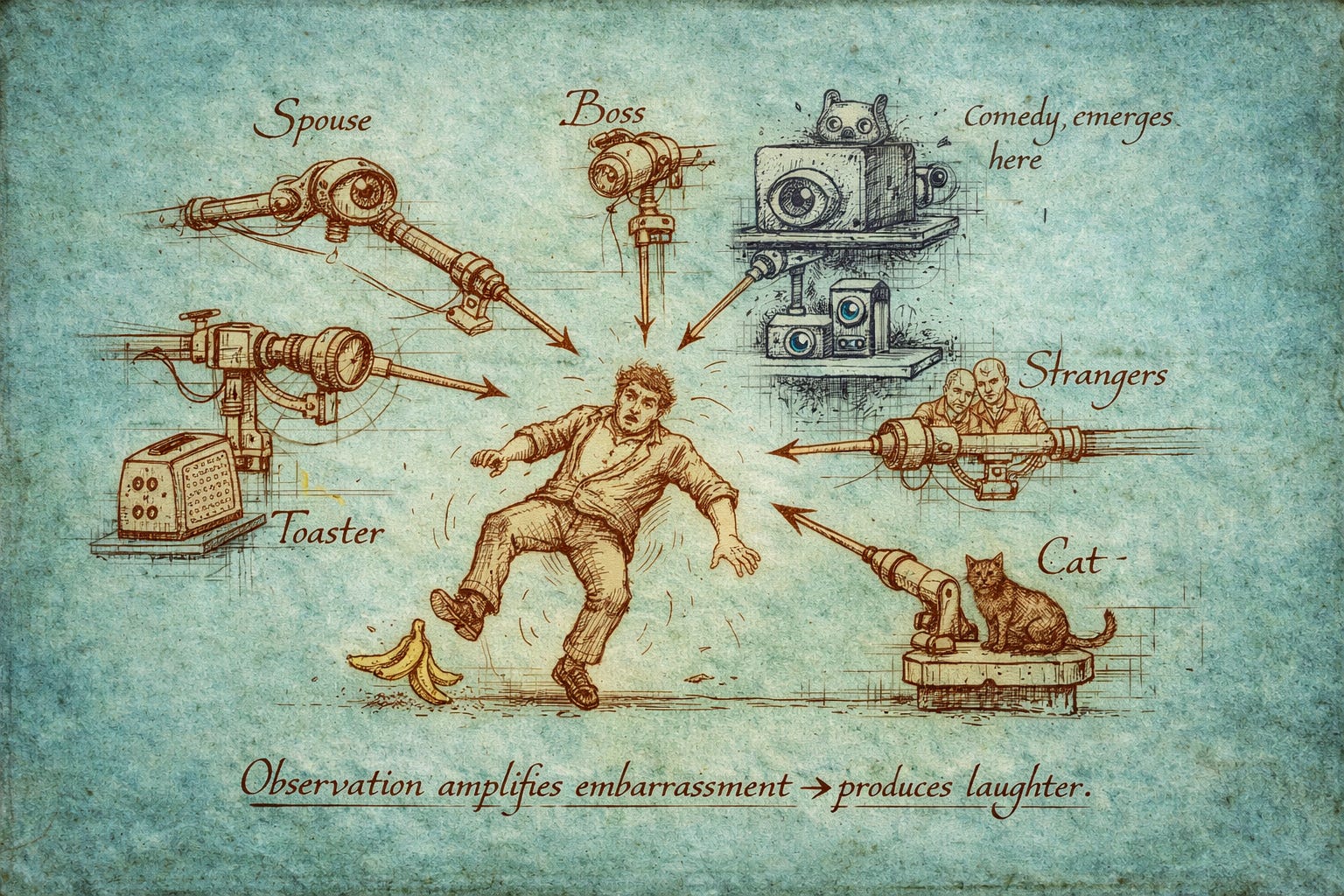
The Four Levels
Not all witnesses are created equal. They operate on a spectrum from literal to metaphysical, and the best stories stack multiple types.
Literal Witnesses are the people physically present during your moment of failure. Your spouse standing in the doorway. Your boss watching from across the room. The teenager at Home Depot silently judging your third visit in one night. Literal witnesses work because they add social consequence… someone saw you mess up and now you have to live with that look that says “I’ve lost all respect for you as an adult.”
Phantom Witnesses are the people who aren’t there but whose voice is in your head anyway. Your wife isn’t home, but you can already hear what she’s going to say. Your mother would be horrified. Your Army buddies will never let you forget this. Phantom witnesses work because they reveal that the protagonist knows better. You’re hearing the voice of reason and ignoring it anyway.
Institutional Witnesses are systems, records, and structures that document your failure. The Ring camera footage capturing you falling off your ladder. The reply-all email that went to 400 people. Institutional witnesses work because they’re permanent and you can’t talk your way out of hard evidence.
Absurd Witnesses are the ones that shouldn’t be watching but are. Your cat. The universe itself. God. An inanimate object that seems to be judging you. Absurd witnesses signal to the audience that your situation has gotten so ridiculous that even objects are shaking their heads.
The more levels you stack, the funnier the story gets because you’re adding pressure. And they’re easy to write because they’re not jokes, they’re true moments you lived through.
How It Works
In my story about surviving an Italian Christmas Eve dinner, the situation is simple: I’m too full. That’s it. That’s the entire problem. I ate too much at a dinner in Italy and I didn’t want to offend anyone by tapping out.
If I told it that way, “I went to dinner in Italy and ate too much,” you’d nod politely and wait for the actual story. One person, one problem, no pressure.
But here’s what actually happened. I’m trapped at a table on Christmas Eve with Uncle Luigi, a 79-year-old olive oil patriarch whose ringtone is the theme from The Godfather…. he’s treating my plate like the hole in the ground at Chernobyl, filling it like an entire community depended on it. I look to my wife for support, but she gets to pass on half the courses because she has food allergies. I’m surrounded by 15 Italians who are all having the times of their lives. I’m the only one struggling. I tried ChatGPT to translate “I’m trying to save room for dessert,” but it apparently told them I’m a professional hot dog eating champion. I hid food under my napkin. They brought me another plate.
That’s five witnesses stacked.
Uncle Luigi is literal … he’s staring at me like I insulted Naples.
My wife is phantom — she’s right there but can’t help, which is somehow worse than being alone.
The 15 Italians are literal … watching, enjoying themselves, completely unaware I’m dying.
ChatGPT is institutional - even the technology betrayed me.
And the plate? The plate isn’t mine anymore. It’s Uncle Luigi’s plate. I’m just Tupperware with legs.
Same situation: I ate too much. But the audience isn’t laughing at overeating. They’re laughing at a man losing his shit while the entire room conspires against him.
The Conversation I Have Every Week
I hear this all the time. “My story doesn’t have witnesses. It was an internal journey. I went through it alone.”
Ok. So who was watching?
“No one. That’s what I’m telling you. I went through this alone.”
That’s a therapy session with no therapist. It’s not a story.
Stories involve active participants out in the world experiencing people. If you went through something completely alone, with no one watching, no one reacting, no voice in your head, no system documenting it, no object working against you, then you have two choices.
Dig deeper. Because I promise you, someone was there. Your spouse had an opinion. Your boss was waiting. Your phone was buzzing. Your body was betraying you. The barista who made your coffee that morning saw the look on your face. Witnesses are hiding in every story. Many storytellers just haven’t been taught to look for them. Or bury it and find a better story.
I know that hurts – your story needs a shovel… either to dig for more, or to bury it forever.
That’s the hard truth about the Witness Stack. It’s not a decoration you add to a finished story. It’s a diagnostic. If you can’t find witnesses, the story might never be A+.
These aren’t comedy techniques. They’re architecture. And most speakers have never been shown how to build with them.
If you sell from the stage and your stories are getting the smile-and-nod you give someone’s vacation slideshow, you are looking at your presentation as a presentation. I see shows. Shows that people are happy to watch.
